Tell Your Story: Prepare for Your Next Interview with STAR and CCAR
Capitol Career Consulting ·
You have experience, accomplishments, and lessons worth sharing. The challenge in an interview is choosing the right example and explaining it clearly enough that the interviewer understands your contribution.
When someone asks, “Tell me about a time when…,” a well-prepared story helps you respond with focus and confidence. Two useful frameworks—STAR and CCAR—give those stories structure.
Understand the frameworks.
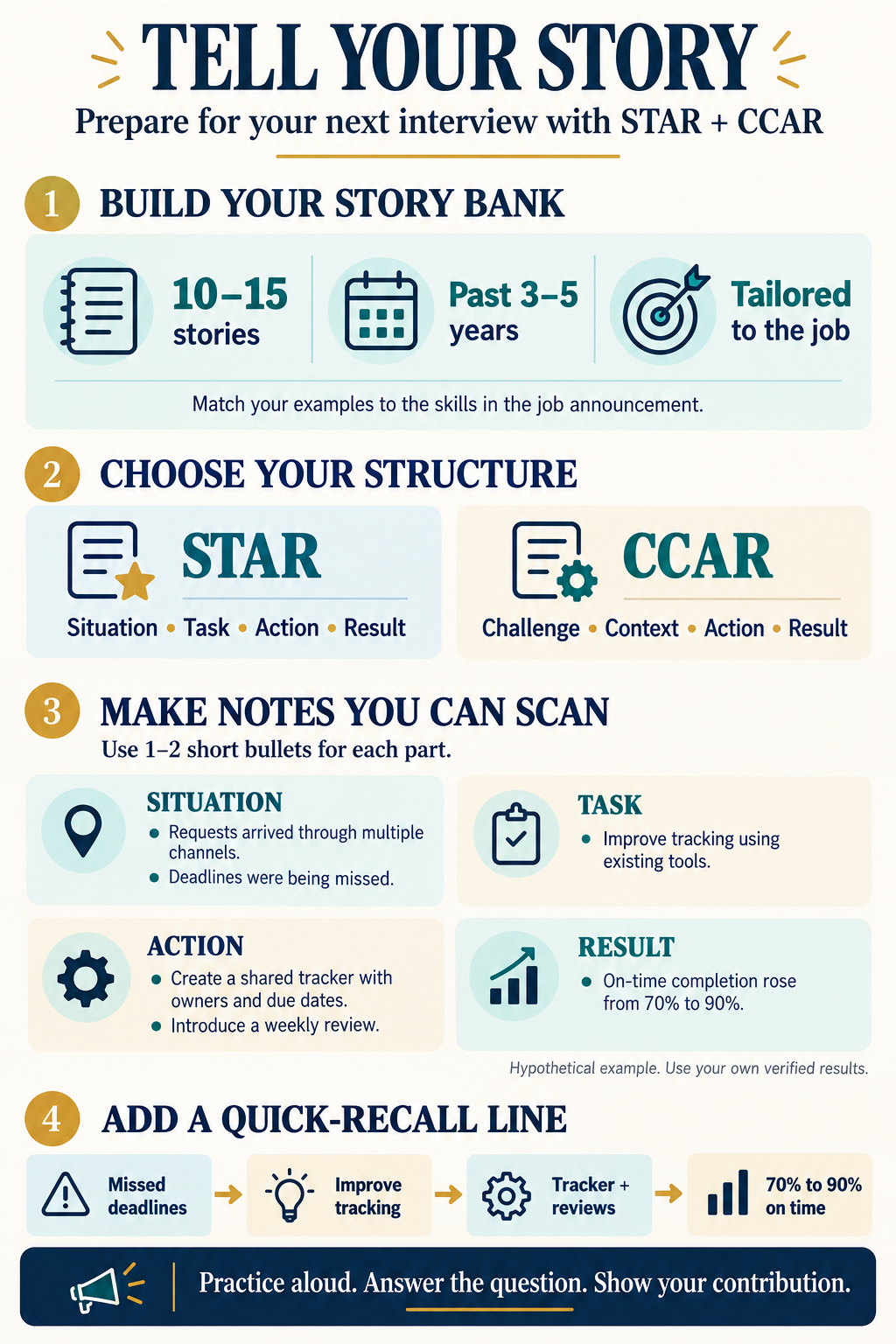
STAR stands for:
- Situation: What was happening?
- Task: What were you responsible for accomplishing?
- Action: What specific steps did you take?
- Result: What happened because of your actions?
CCAR stands for:
- Challenge: What problem or obstacle did you face?
- Context: What circumstances made it challenging or significant?
- Action: How did you respond?
- Result: What changed, improved, or was achieved?
Both approaches help you explain your experience from beginning to end. STAR makes your responsibility explicit, while CCAR gives additional attention to the challenge and its surrounding circumstances. Choose the approach that helps you tell each story naturally.
Build a collection of 10–15 stories.
Before your next interview, aim to develop a collection of 10–15 examples, primarily from the past three to five years. This gives you a range of experiences to draw from when questions cover different skills or situations.
Start with examples involving leadership, problem-solving, teamwork, communication, competing priorities, process improvement, and adapting to change. Include a setback or mistake that led to a meaningful lesson.
Recent examples help demonstrate your current capabilities, but an older accomplishment can still be useful when it is especially relevant. If you are early in your career, consider experiences from internships, school, volunteer work, or community activities.
Give each story a short, recognizable title, such as “Reducing the Backlog,” “Resolving a Team Disagreement,” or “Delivering Under a Tight Deadline.” These titles make examples easier to find and recall.
Tailor your stories to the job.
Your collection should reflect the positions you want to pursue.
Review the job announcement and identify its major responsibilities and required skills. Then match your stories to those requirements. For a supervisory position, prioritize examples involving coaching, accountability, delegation, and team performance. For an analytical position, emphasize how you assessed information, identified a problem, developed options, and supported a decision.
Label each story with the skills it demonstrates. One example might show project management, collaboration, and problem-solving, but the emphasis should change depending on the question.
As you apply for different roles, update your collection and identify the examples most relevant to each opportunity.
Prepare brief notes you can scan.
For each story, write one or two short bullets under each part of STAR or CCAR. Use keywords, decisions, and verified results that help you remember the experience.
Here is a hypothetical STAR example:
Story: Improving Request Tracking
Relevant skills: Process improvement, organization, collaboration
Situation
- Requests arrived through multiple channels, making ownership difficult to track.
- The team was missing internal deadlines.
Task
- Improve tracking and on-time completion using existing tools.
Action
- Review the workflow with staff and create a shared tracker with assigned owners and due dates.
- Introduce a weekly review to identify overdue items and resolve obstacles.
Result
- On-time completion increased from 70% to 90% over three months.
- Managers gained a clearer view of outstanding work.
The notes give you enough detail to reconstruct the story without memorizing a paragraph. During practice, turn those cues into a natural explanation in your own words. If the interview permits notes, the same format makes them easy to glance at briefly.
Add a quick-recall line.
At the bottom of each story, summarize its progression in a short sequence:
Missed deadlines → Improve tracking → Shared tracker and weekly reviews → On-time completion increased from 70% to 90%
This line acts as a memory cue. One glance reminds you where the story begins, what you needed to accomplish, what you did, and how it ended.
Keep the wording specific to that example. “Situation → Task → Action → Result” reminds you of the framework; the story-specific sequence helps you remember the actual experience.
Make your contribution and results clear.
Give enough background to establish the stakes, then spend most of your answer explaining your actions and their impact.
Acknowledge the team’s work while identifying your own contribution. Explain what you assessed, recommended, created, coordinated, or decided. Use accurate numbers when available, but remember that results can also include resolving a concern, clarifying responsibilities, meeting a deadline, or improving a decision.
When an outcome falls short, explain what you learned and how you applied that lesson.
Practice choosing the right story.
Practice aloud with different interview questions. Listen carefully to what each question asks, select a relevant example, and adjust your emphasis accordingly. Avoid forcing a favorite story into a question it does not answer.
Your collection should grow as your career develops. Add new accomplishments while the details are fresh, refresh the results, and revisit your strongest examples before each interview.
With a relevant collection of stories, concise notes, and a clear structure, you can help interviewers understand both what you have accomplished and how you approach your work.
Preparing for your next opportunity? Our career consultants can help you identify your strongest stories, tailor them to your target role, and practice communicating your value with confidence.